
In digital marketing, landing pages are one of the most important tools for helping website owners reach their marketing goals. Whether you want to collect leads, increase sales or build brand awareness, landing pages are an ideal solution.
In this guide, we’ll look at what landing pages are, why they matter, the different types and how to use them to increase your conversion rates.
What Are Landing Pages?
Landing pages are standalone web pages designed specifically to reach one marketing goal. Unlike a website’s regular pages, landing pages don’t have lots of navigation links. They focus on guiding visitors toward one specific action, such as subscribing to a newsletter, downloading an ebook or completing a purchase.
You can also think of landing pages as the pages users reach after clicking an ad, whether the ad was on a search engine, a website, social media or in an email.
These pages are designed with one main purpose: guiding visitors or users to take a specific action (a call to action), such as signing up for a service, buying a product or filling in a form to get free content, such as an ebook or a free course. Through that action, the visitor becomes a lead or a customer.
Why Do We Use Landing Pages?
As we said, landing pages aren’t ordinary pages on a website. They’re designed specifically to support particular marketing campaigns, with the aim of turning visitors into customers.
That’s why the information on them should be enough to get a response without needing any other contact. Beyond that general goal, they have several important secondary goals:
- Sending users straight from ads: a landing page gives visitors a smooth experience, with all the details they need about the product or service, which saves them time and effort searching.
- Collecting leads: landing pages help you get new users’ details, which makes it easy to follow up and contact them later.
- Highlighting specific offers: if you offer several products or services, you can use landing pages to focus on special offers, such as a free book or a limited-time discount.
- Sending users straight to checkout: a landing page gives customers the information that encourages them to buy, then takes them straight to the checkout page, which makes it an effective tool for ecommerce and digital subscriptions.
Why Landing Pages Matter, and What They Achieve
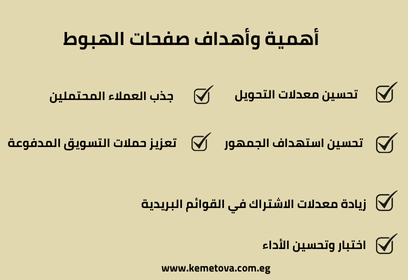
Landing pages matter because they help you:
- Improve conversion rates: because they focus on one goal, landing pages increase conversion rates compared with regular pages.
- Attract leads: landing pages collect leads’ details through sign-up forms, which makes it easy to follow up later with email marketing or phone calls.
- Target your audience better: you can design landing pages for specific audience groups, which makes them more effective than general ads.
- Strengthen paid marketing campaigns: landing pages are often used with paid ad campaigns, such as Google and Facebook ads, to get the most from paid traffic.
- Grow your email list: landing pages are used in email marketing strategies to increase subscribers, so you can keep in touch with leads.
- Test and improve performance (A/B testing): landing pages let you test different elements, such as headlines, images or call-to-action (CTA) buttons, to increase your conversion rate.
Read also: how to analyze social media ads with data.
Types of Landing Pages
Landing pages generally fall into two types. Both ultimately aim to increase profits and sales, but they differ in approach and main goal.
Lead generation landing pages
These pages collect visitors’ details, including their name, address and email, through sign-up forms. The goal is to add them to your mailing list so you can contact them in the future and turn them into customers, and to use the information to build accurate customer personas.
These pages have a simple design, with a short marketing message and fields for entering details. It’s best not to ask for too much information; stick to a name and one way to get in touch, whether a phone number or email address, so you don’t put visitors off and make them leave without completing the form.
Some sites ask for a user’s card details as a way to check they’re serious, which helps target leads who genuinely intend to buy once they’re convinced by the product.
Because many people hesitate to share personal information without a clear benefit, it’s best to offer an incentive, such as a free trial, a gift like an ebook, or a discount coupon for the product or service.
Click-through landing pages
This type of landing page introduces users to the features of a product and ends by sending them to the purchase page with a call-to-action (CTA) button.
These pages are longer than lead generation pages. They include plenty of information about the product, with creative details that support the decision to buy. This approach is what makes successful sales pages work, and it can increase conversion rates significantly.
Some click-through landing pages are relatively long, because they’re designed for three different levels of user, split into three main sections:
- Section one: delivers the marketing message briefly and directly, followed by a CTA button that prompts the desired action.
- Section two: gives more details about the product and its benefits, followed by another CTA button to encourage engagement.
- Section three: includes elements that do more to persuade visitors to buy, such as testimonials and positive reviews from past customers.
This way, the page meets the needs of three types of visitors, depending on how much persuasion each needs, which increases the chances of conversions and sales.
How to Use Landing Pages to Increase Conversions
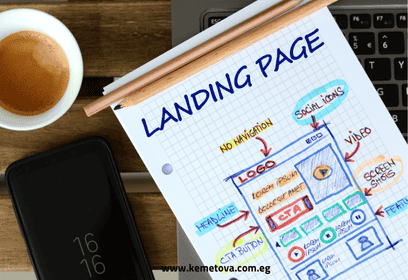
As we said, the goal of a landing page is to get a purchase. So it needs attractive elements that catch visitors’ attention and encourage them to explore the product and consider buying it.
The most important things to include to increase your conversion rate:
- An attractive, clear headline: it should catch the eye and make clear the value visitors will get.
- A simple, focused design: avoid complex designs, and use a clear layout that guides visitors toward the action you want.
- A clear call-to-action (CTA) button: use an attractive color and a short, clear phrase, such as “Sign up now” or “Get the free offer.”
- High-quality images and videos: they increase visitor engagement and show the value of the product or service.
- Fast loading: users and visitors don’t like waiting, so make sure your page loads quickly so you don’t lose potential customers.
- Customer testimonials and reviews: showing past customers’ experiences builds trust and helps persuade visitors to take action.
- Search engine optimization (SEO): use the right keywords and optimize the title and meta description so your page appears in organic search results.
- A/B testing: create two different versions of the page and test which gets better results, to improve your conversion rates.
- Ongoing data analysis and improvement: use analytics tools such as Google Analytics to find your page’s strengths and weaknesses, and improve it for the best results and higher conversion rates.
Landing pages are a powerful tool for website owners and marketers who want to increase conversion rates and reach their marketing goals effectively. By designing an outstanding landing page and improving it continuously based on data and analytics, you can get great results in any marketing campaign.
Strategies such as SEO, A/B testing and analyzing user behavior can also help you reach higher conversion rates.
Start creating a polished landing page today, and watch your conversion rates rise. At Kemetova, we offer a full range of digital marketing services and design landing pages that reach your marketing goals, as well as web hosting and domain registration in Egyptian pounds. Get in touch with the Kemetova team with any questions.