Search engines have become a core part of online marketing. Whether you own a website or run a business online, improving your visibility in search engines can help you attract more visitors and potential customers.
Search marketing is one of the most important digital marketing strategies, and it includes two main types: search engine optimization (SEO) and search engine marketing (SEM). Both play a big part in making websites more visible.
As marketing evolves, along with the tools and strategies marketers use to reach their goals, the two terms often get confused, and some people think they mean the same thing. In this article, we’ll explain the difference between SEO and SEM, the role of each, why each matters and when to use them to improve your business’s performance.
What Are Search Marketing Strategies?
It’s important to understand search marketing terms and the differences between them before using any strategy to market your business. It helps you choose the best approach for your business and avoid wasting time, effort and money.
Search marketing includes any approach that helps a brand attract target customers by appearing on search engine results pages (SERPs). But ranking higher and bringing more visitors to your site takes specific, organized effort.
Search marketing strategies fall into two main categories:
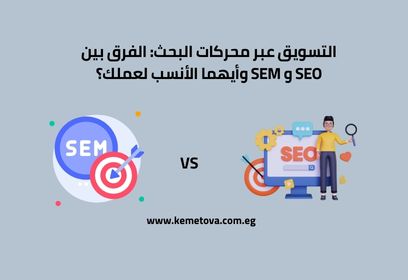
- Search engine marketing (SEM): relies on paid ads to appear in search results.
- Search engine optimization (SEO): relies on natural methods to improve how websites rank in search results.
The main difference between them is that SEM relies on paid ads, while SEO relies on free improvements to get better results.
What Is SEM?

Simply put, search engine marketing (SEM) is a paid digital marketing strategy built on pay-per-click (PPC) search ads, which let marketers or advertisers show their ads at the top of search results in return for a cost per click.
SEM is a core part of search marketing strategy, because it helps you get more visibility on search engine results pages (SERPs). It covers setting up and optimizing ads and setting the budget for showing them.
This approach is known as paid search or pay-per-click (PPC) marketing, and it runs on platforms such as Google Ads. Brands choose the right keywords and create ad campaigns that target them, so their ads appear at the top or bottom of the search results when people use those keywords.
Google charges for every click on the ad, which makes budget management and setting strategic goals essential for success with this type of marketing.
What Is SEO?
Search engine optimization (SEO) is a search marketing strategy that aims to make your site more visible in organic search results (SERPs) using natural methods, without paying. Brands use a set of techniques that help their content rank higher and appear more often in search results.
The main goal of SEO is to increase free, organic traffic by improving your content quality, site structure and user experience.
SEO includes many methods that improve a site’s ranking, usually divided into three main categories:
On-page SEO:
This type focuses on optimizing each page on your site by targeting specific keywords. Methods include:
- Keyword research.
- Content creation.
- Optimizing how keywords are used.
These methods help search engines understand the page’s content better, which increases its chances of ranking at the top.
Technical SEO:
This type focuses on improving the technical side of your site to strengthen its back end. Methods include:
- Improving site speed.
- Mobile compatibility.
- Better crawling and indexing.
- Site structure.
- Structured data.
- Better security.
Off-page SEO:
This type focuses on improving your site’s reputation and authority by connecting it with high-quality sites. Off-page SEO methods include:
- Link building, by earning strong backlinks from trusted sites.
- Managing local listings.
- Optimizing business profiles.
The more trusted sites link to yours, the more likely search engines are to treat it as a trusted source, which improves its ranking in search results.
What’s the Difference Between SEO and SEM?
SEO and SEM are both core parts of digital marketing strategy. They’re similar, but there are clear differences between them.
The main difference between SEO and SEM is that SEO relies on natural, unpaid strategies to improve a site’s visibility in free search results, while SEM relies on paid ads to reach the same goal.
Here’s a quick comparison of SEO and SEM:
- Cost: SEO doesn’t need a direct budget for clicks, but it takes ongoing time and effort. SEM needs a continuous ad budget, because you pay for every click.
- Time to results: SEO takes several months to get real results. SEM shows results immediately when the ad campaign launches.
- Longevity: SEO has a long-term effect and can keep bringing traffic for years. SEM’s effect ends as soon as the campaign stops.
- Control: with SEO, you have less control, because results depend on changes to search algorithms. With SEM, you have full control over your ads and target keywords.
- Trust and credibility: SEO is more trusted by users because it appears naturally. With SEM, some users avoid paid ads and prefer the organic results at the top.
Which Is Better: SEO or SEM?
SEO improves your site’s credibility in search results for free. But to get there, you need to create high-quality content and share it regularly on social media and other channels. In short, you need to offer valuable, useful content that encourages visitors to engage as soon as they arrive on your site.
SEM isn’t a long-term solution, but it’s an effective first step.
SEO and SEM often complement each other, but you can’t use the two terms interchangeably, because each is a separate concept.
In fact, many marketers see SEO as a key part of SEM, the foundation that makes search marketing strategies succeed. So you can’t say one is better than the other; the right choice depends on your business and your marketing goals.
You can’t do successful search marketing without SEO, so neither one is simply better than the other.
Search marketing has become essential for reaching current and potential customers. But you need to understand its types and the differences between them to use it effectively for your marketing goals.
Not sure where to start? At Kemetova, our team of digital marketing experts specializes in both SEO and SEM, and we can help you build an effective strategy to make your business and campaigns more visible in search engines. Get in touch with the Kemetova team with any questions.
At Kemetova, we also offer a full range of web hosting services and domain registration in Egyptian pounds for your online business.