
Summary
A technical and commercial comparison of WooCommerce, Shopify and a custom-built store for Egyptian merchants: payments, cash on delivery, Arabic quality, three-year cost layers and a 30-day proof method.
Most merchants ask the wrong first question. They ask which platform is best. The useful question is which operating model fits the business: who will run the store day to day, how orders reach the customer, how money reaches the bank, and how much of the process is specific to you. In Egypt those answers differ from the defaults baked into global platforms, and that difference is where the WooCommerce, Shopify or custom store decision is really made.
This guide compares the three options as engineering and operations choices, not as brand preferences. It is based on public platform documentation checked on 18 October 2026, not on benchmarks or fee schedules, and it names no prices. Platform pricing and regional payment availability change often, so treat every commercial detail below as something to confirm on the vendor page before you commit.
The three options, defined precisely
WooCommerce is open-source commerce software that runs inside WordPress on a server you choose. You own the code, the database and the hosting decision. The core is free; everything around it (hosting, theme, extensions, payment integrations, security, maintenance) is yours to select and pay for.
Shopify is a hosted commerce platform. Shopify runs the servers, the checkout, security patching and uptime. You rent the platform, configure it through an admin and an app ecosystem, and customise the storefront inside the limits Shopify sets.
A custom store is a commerce application built for your business, usually on a framework such as Laravel, with your own data model, checkout rules and integrations. It can use proven components (payment SDKs, search, queues) but the business logic is written for you.
The trade across all three is the same: control against responsibility. The more control you take, the more you must operate. Shopify minimises what you operate. A custom store maximises what you can change. WooCommerce sits in the middle with a large ecosystem and a fully open codebase.
WooCommerce: what it does well and where it costs you

WooCommerce is strongest when the store is part of a larger content website. Because it lives inside WordPress, product pages, blog content, landing pages, multilingual layouts and SEO tooling share one system and one editorial workflow. For a merchant whose traffic comes from articles, guides and category pages as much as from ads, that is a real advantage.
Technically, recent WooCommerce versions have matured. High-Performance Order Storage (HPOS) moves orders out of the generic WordPress posts tables into dedicated tables, which means fewer reads and writes per order and a structure that scales better. According to the official WooCommerce HPOS documentation, it is enabled by default on new installations from version 8.2, while existing stores can migrate to it.
Where WooCommerce costs you:
- You are the operator. Updates, backups, security and uptime are your responsibility or your agency’s. A store without a maintenance owner decays: outdated extensions are the usual entry point for compromised sites.
- Extension sprawl. Every missing feature is tempting to solve with another plugin. Each one adds code you did not write, update cycles you must track and potential conflicts at checkout.
- Performance is engineered, not given. Page speed depends on hosting, caching, image handling and theme quality. It can be excellent, but it will not be excellent by default.
- Complex rules hit a ceiling. Per-customer pricing, multi-warehouse allocation, subscription logic with proration or custom approval flows can be done, but the more you stack on extensions, the more fragile the result.
Shopify: what it does well and what Egypt changes
Shopify is strongest when the priority is launching fast, with low operational overhead, for a product catalogue that fits standard commerce patterns. You do not manage servers. Checkout is maintained by Shopify, the admin is polished and the app ecosystem covers most common needs. For a small team with no technical staff, that removes a whole category of risk.
The Egypt-specific facts matter more than the feature list. Shopify publishes an official list of countries supported by Shopify Payments, and Egypt is currently not included. Shopify advises merchants in unsupported countries to use a third-party payment provider.
First, third-party gateways on Shopify are generally subject to an additional Shopify transaction fee on top of the gateway’s own charges, with the rate depending on your plan. Confirm the current figure on Shopify’s pricing page and add it to your payment cost model alongside the gateway fee.
Second, the gateway integration is a dependency you do not control. In July 2024 Paymob announced an expanded partnership with Shopify offering embedded card and wallet checkout for merchants in the region, keeping the customer inside the Shopify checkout rather than redirecting to an external page. The public announcement does not specify which countries it covers or which payment methods are live today, so verify with Paymob and Shopify that your exact setup (Egypt merchant account, EGP, wallets, settlement) is supported before you design around it.
Shopify also constrains how far you can bend checkout and back-office logic. Many stores never need to. But if your business depends on cash on delivery verification, partial payments, deposit-and-balance flows or custom approval steps, test those requirements against the platform before you sign up, not after.
The custom store: when building is the right answer
A custom store is rarely the right first store. It is the right store when the commerce logic is the business. Typical triggers include: pricing that depends on the customer, contract or volume; stock allocated across several locations or suppliers; order approval chains; deep integration with an ERP, warehouse or courier system; marketplace behaviour with several sellers; or a bilingual Arabic and English experience where the standard templates keep fighting the design.
The cost of custom is not only the build. You also own the roadmap, the security posture, the payment integration maintenance and the knowledge of how the system works. A well-run custom build documents its decisions, tests its payment flows and keeps the code in a repository the client owns. A poorly run one makes the merchant dependent on a single developer.
There is a pragmatic middle path that we recommend often: keep WordPress as the content and SEO front end, and move the commerce engine (pricing, availability, order workflow) into a Laravel application behind an API. You keep editorial speed and gain control where the rules are complex. Our ecommerce development work covers both ends of that spectrum, and the Laravel and WordPress pages describe how we approach each.
Factors specific to Egyptian merchants
Global comparisons ignore several realities that decide whether an Egyptian store converts and settles cleanly. Design the platform choice around these.
Payment methods
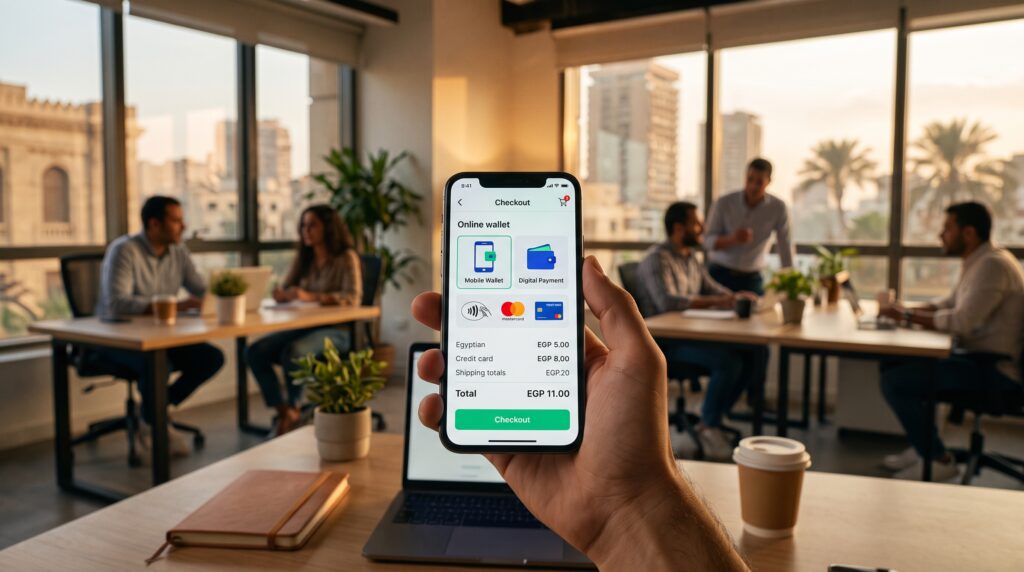
Egyptian shoppers pay by card, mobile wallet, cash at a Fawry outlet, bank transfer including InstaPay, and cash on delivery. A platform has to support the mix your customers actually use, not only cards. Check, for each candidate platform, which Egyptian gateways have maintained integrations, how asynchronous payments such as pay-at-outlet vouchers are handled, and whether the order status updates reliably from the gateway callback. We cover the integration mechanics in our guide to connecting Paymob, Kashier and Fawry to WooCommerce or Laravel.
Cash on delivery operations
If a large share of your orders is cash on delivery, the platform is only part of the system. You need order confirmation by phone or message, courier handoff, collection reconciliation and a returns flow. Ask who builds and maintains each of those. On a hosted platform you will rely on apps; on WooCommerce on extensions or custom code; on a custom store you can design the whole flow, including courier API integration and per-order collection status.
Currency and pricing display
Your catalogue is priced in Egyptian pounds, but you may also serve international buyers. Decide early whether EGP is your only transaction currency, and how a gateway settles. Test rounding, taxes and refund amounts in EGP end to end.
Arabic and RTL quality
Arabic storefronts expose weaknesses in templates fast: broken alignment of prices and icons, mixed-direction text in product titles, search that ignores Arabic spelling variants and emails that render badly. Test a real Arabic product page and a full Arabic checkout on each candidate, not a demo in English.
Invoicing and compliance
Egyptian tax authority requirements for electronic invoicing and receipts apply to many businesses, and the right setup depends on your registration and sales model. Ask your accountant what you must issue, then confirm how each platform produces and transmits it. Data you collect about customers also falls under Egypt’s personal data protection law, which affects where data is stored and how consent is recorded.
A total-cost view over three years
Comparing launch price is the most common mistake. A fair comparison counts five layers over at least three years.
- Acquisition: design, configuration or development, content migration and testing.
- Platform and hosting: subscription or hosting, plus the apps or extensions you need to reach feature parity.
- Payments: gateway fees, any platform transaction fee on top, and settlement timing. Model these on your real order volume and average order value.
- Operations: maintenance, security, backups, monitoring, support and the staff time to run the catalogue.
- Change and exit: what it costs to add a feature in year two, and what it costs to leave. Data export, URL preservation and redirect work all belong here.
When you request quotes, ask every vendor to price the same five layers against the same written requirements. For a budgeting reference, see our page on ecommerce website cost in Egypt.
Seven questions that decide it
- Who runs the store daily? A non-technical team with no agency retainer points to Shopify. A team with an agency partner can run WooCommerce well.
- How much of your content strategy is editorial? If guides, comparisons and landing pages drive acquisition, WooCommerce inside WordPress is a natural fit.
- How standard is your checkout? Standard card checkout favours hosted platforms. Deposits, approvals, cash-on-delivery verification or tiered pricing favour WooCommerce with custom code or a custom store.
- What must integrate? An ERP, warehouse system or courier API is easier to integrate cleanly into code you control.
- How many SKUs and variants? Large catalogues with complex attributes need careful data modelling on any platform. Test an import before you choose.
- How much downtime or security risk can you absorb? Hosted removes most of it. Self-hosted requires a maintenance plan with named owners.
- What is the three-year plan? If you expect to add marketplace sellers, wholesale accounts or a mobile app, favour an architecture with a clean API from the start.
Scenarios and typical fits
A boutique brand launching with fewer than a few hundred products, card and wallet payments, and a small non-technical team. Shopify is a reasonable fit once you have verified the payment path for your Egyptian merchant account. WooCommerce is equally valid if you already have a content website and an agency.
A merchant with an established WordPress site, strong organic traffic and an existing editorial team. WooCommerce keeps content, SEO and commerce under one roof. Invest in hosting, caching and a maintenance plan.
A distributor or wholesaler with customer-specific prices, credit terms and approval workflows. This is custom-store territory, or a WooCommerce front end backed by a Laravel engine. See our guide to hosting in Egypt or abroad if your buyers and integrations are concentrated in one region.
A multi-vendor marketplace. Plugins can start a marketplace, but commission logic, payout reconciliation and seller verification usually outgrow them. Plan for custom.
Performance and SEO considerations
Search traffic is decided by crawlable pages, clean URLs, structured data, fast templates and good content, not by platform logos. All three options can rank. What differs is how much you must engineer. On WooCommerce and custom builds you control URL structure, canonical rules, hreflang for Arabic and English, schema markup and server response time directly. On Shopify you work within its URL conventions and theme layer, which is fine for most stores but limits some structural choices.
For any option, measure real pages: product pages, category pages with filters, search results and checkout on a mid-range mobile phone over a typical Egyptian mobile connection. Treat Core Web Vitals as acceptance criteria in the contract rather than a nice-to-have.
A 30-day proof method before you commit
Do not choose on demos. Build a thin slice of your real store on the leading two options and judge them on evidence.
- Import fifty real products with real variants, Arabic and English titles and your actual images.
- Configure your real shipping zones, a cash-on-delivery path and one online payment method in a test environment.
- Place ten test orders covering success, failure, abandoned payment, partial refund and a returned item.
- Have the person who will run the store daily complete the same ten tasks: edit a price, add a product, process a refund, export orders, change a delivery rule.
- Record time taken, errors encountered and workarounds needed. The platform with fewer workarounds for your real flows wins, whatever its brand.
Migration and exit planning
Any platform decision should include its exit. Insist on a documented export of products, customers and orders, a list of all URLs that currently rank, and a redirect plan. Moving later is entirely possible, but the bill is lower when you plan for it on day one.
A good platform choice is the one your team can operate reliably in year three, with payments that settle cleanly and an order flow that does not depend on one person’s memory. If you want the options compared against your actual catalogue, payment mix and delivery model, our team can scope that comparison as a short engagement before any build begins.