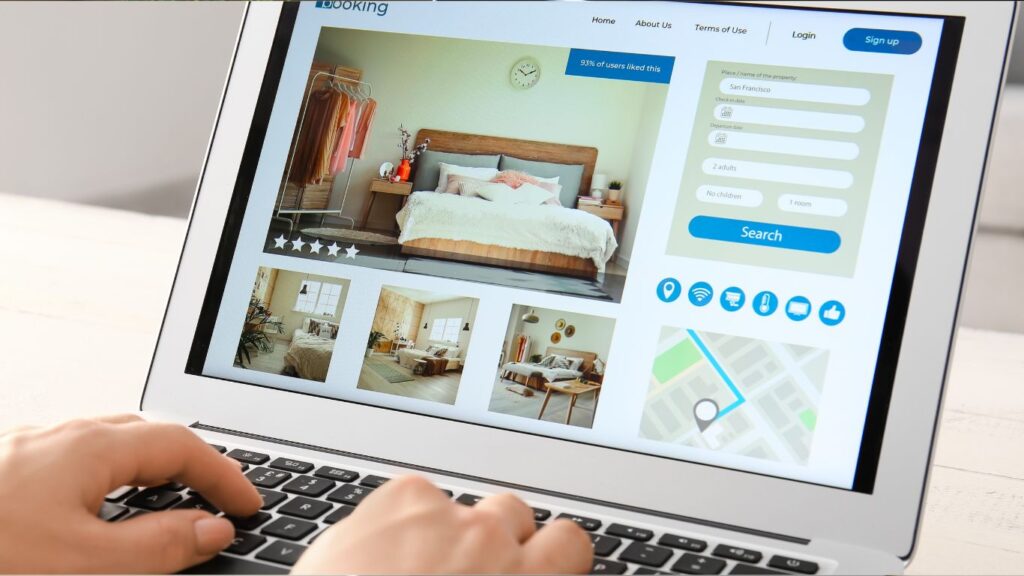
A Hurghada hotel that sells 45 percent of its rooms through Booking.com does not have a distribution problem. It has a margin problem that looks like a distribution strategy. The commission line is the largest variable cost many resorts carry after payroll and food, and it is rarely audited with the rigour applied to energy bills or supplier contracts.
Direct booking vs Booking.com becomes much easier to evaluate when you put real numbers behind both channels. In this article, we use publicly reported commission ranges, a worked example for a 120-room resort, and a break-even model for a direct booking site. We then cover the engineering decisions that determine whether a direct channel actually converts, including booking engine architecture, channel manager sync, payments, multilingual SEO and measurement. Kemetova builds this kind of system for hotels and hospitality businesses, so we will also explain when a direct booking site does not pay off.
What Booking.com Actually Charges
Booking.com does not publish a single public price list. Terms sit in the partner portal and vary by country, property type and the programmes a property joins. What is publicly reported is consistent enough to plan with. The standard commission is commonly described as starting around 15 percent of each reservation, and industry guides put the typical range at 15 to 18 percent for the base tier. Properties that switch on visibility programmes commonly end up in an 18 to 22 percent band.
Three mechanisms push the effective rate above the headline number:
- Preferred Partner Programme. Opting in adds a commission increment in exchange for better placement in search results. The uplift is set in your contract, so read it rather than relying on a blog post, including this one.
- Genius discounts. The property funds a discount for a segment of logged-in guests. It does not appear on the invoice as commission, but it is revenue you give up on every Genius booking.
- Visibility boosters and campaigns. Temporary commission increases tied to ranking or promotional placement. They are easy to accept during a slow month and easy to forget afterwards.
Booking.com itself confirms that properties pay commission on reservations and that the exact commission percentage is shown during the agreement process. You can review the official Booking.com information about property commissions for more details.
The practical conclusion is that the contracted base rate is not your cost of acquisition. Your effective rate is the sum of the base commission, programme increments and discounts you fund, divided by gross booking value. Most hotels have never calculated it. The first task in any distribution review is to calculate it from twelve months of invoices.
A Worked Example: A 120-Room Resort in Hurghada
The figures below are assumptions chosen to be realistic for a mid-scale beach resort. They are not client data. Replace them with your own numbers from your property management system and Booking.com extranet.
- 120 rooms, 70 percent annual occupancy, average daily rate of US$65.
- Total room revenue: 120 x 365 x 0.70 x 65 = roughly US$1,993,000.
- Share sold through Booking.com: about 45 percent, which is US$900,000 in gross booking value.
At that volume, the commission bill depends heavily on which rate applies:
- At 15 percent: US$135,000 per year.
- At 18 percent: US$162,000 per year.
- At 22 percent: US$198,000 per year.
The gap between the bottom and top of the reported range is US$63,000 a year on one channel. That is more than the annual cost of most hotel websites, booking engines and the retainers that maintain them combined.
Now add the discount layer. Suppose 30 percent of Booking.com reservations carry a 10 percent Genius discount. Those reservations total US$270,000 after the discount, which means they would have been US$300,000 at your standard rate. You gave up US$30,000 in rate, and Booking.com still charged commission on the discounted amount. Added to an 18 percent base commission, the true cost of the channel is closer to US$192,000, or about 21 percent of the gross booking value you see in the extranet.
What a Direct Booking Channel Costs
Direct is not free, and any agency that tells you it is should be treated with suspicion. A direct booking carries its own costs:
- Payment processing. Card gateway fees. We model 2.5 percent in the example, but your acquirer’s rate sheet decides the real figure.
- Demand generation. SEO, Google Business Profile, metasearch and retargeting. We model 5 percent of direct revenue. Repeat guests and WhatsApp enquiries cost far less than new-guest paid traffic, so the blended figure depends on your mix.
- Platform costs. Hosting, booking engine licence or custom build amortisation, channel manager connection, maintenance, security patching and analytics. We model US$12,000 per year.
Variable direct costs in this model total 7.5 percent of direct revenue. Against an 18 percent commission, each dollar moved from Booking.com to the direct channel saves 10.5 cents before fixed costs.
Break-Even and Scenarios
With US$12,000 in fixed annual platform cost and a 10.5 percent net saving per dollar shifted, break-even is US$12,000 divided by 0.105, which is about US$114,000 of redirected gross booking value. That is 12.7 percent of the Booking.com volume in the example. Below that, the direct site is a cost. Above it, the saving compounds:
- Shift 25 percent (US$225,000). Commission avoided: US$40,500. Direct variable costs: US$16,875. Net variable saving: US$23,625. After fixed costs: US$11,625 per year.
- Shift 40 percent (US$360,000). Commission avoided: US$64,800. Direct variable costs: US$27,000. Net variable saving: US$37,800. After fixed costs: US$25,800 per year.
Two conclusions follow. First, the case for a direct channel is volume-dependent, and a 20-room guesthouse with US$100,000 of OTA revenue may never clear its fixed costs. Second, the model understates the benefit for larger properties, because it ignores what a direct channel gives you that an OTA never will: the guest’s email address, phone number, language, travel dates and stay history. That data is what turns a first booking into a repeat booking at a lower acquisition cost.
The model is deliberately conservative in other ways. It assumes no growth in direct revenue from repeat guests, no reduction in OTA programme spend and no improvement in conversion rate during the year. In practice, a property that tracks its funnel usually finds two or three leaks in the first quarter, such as a payment step that fails on certain cards or a mobile form that hides the submit button. Fixing them lifts conversion without any extra traffic spend. Treat the break-even figure as a planning floor, not a forecast.
Why Most Hotel Websites Fail to Capture Direct Bookings
When hotels tell us their website “does not work”, the cause is almost always one of five engineering failures rather than a design problem.
1. The Booking Engine Is a Foreign Object
Many hotel sites send guests to a third-party engine on a different domain, with a different design, slow loading and no tracking continuity. Conversion drops at the handoff. The fix is an engine that runs on your own domain or a tightly embedded flow with consistent branding, shared session data and event tracking across both sides.
There are two sound architectures. The first is a licensed engine connected to your channel manager and embedded through a lightweight widget. It is quick to deploy and acceptable for properties with standard rate structures. The second is a custom booking layer built in Laravel with its own availability and rate logic, synchronised with the property management system through its API. It costs more upfront and is justified when the property has complex packages, multiple room categories, add-on services or a group sales process the licensed engines handle poorly. We cover this decision in depth on our booking systems page.
2. Inventory Is Not Truly Synchronised
A direct site that shows availability the PMS does not honour produces overbookings, and one overbooking at peak season erases months of commission savings. Real-time two-way synchronisation through the channel manager’s API is the standard. Calendar-file syncing (iCal) refreshes on a delay of minutes to hours and is unsuitable for hotels. Test the failure mode, not the happy path: what happens when two guests book the last room within the same minute, and what happens when the API times out during checkout.
3. Direct Rates Do Not Give Guests a Reason to Switch
Guests compare the direct price against the OTA price on their phone within seconds. If the rates are identical, the OTA wins on trust and convenience. The direct channel needs a visible advantage: a member rate for guests who book direct, free breakfast or a late checkout, flexible cancellation terms or a transfer included. These perks cost less than the commission you save, and they should be displayed on the booking widget itself, not buried on a separate offers page.
4. Payment Friction at Checkout
International guests expect to pay by card with 3-D Secure, and Egyptian domestic guests often prefer local methods. A gateway such as Paymob or Kashier handles local card acquiring, and tokenisation lets you store a payment method without holding card data yourself, keeping your PCI scope minimal. Offer a deposit option for longer stays and make the payment terms clear before the final step. Unexpected charges at the last page are one of the most common causes of abandoned carts.
5. The Site Is Slow, Especially on Mobile
Most hotel traffic arrives on phones, often on mobile data in transit. Hero videos, uncompressed galleries and a dozen third-party scripts push the largest contentful paint far beyond the 2.5 second threshold Google treats as good. Set performance budgets before design starts: LCP under 2.5 seconds, INP under 200 milliseconds and cumulative layout shift under 0.1, measured on real devices over a mobile connection. Image formats, lazy loading below the fold, server-level caching and a CDN do most of the work. Our multilingual website builds apply the same discipline across every language version, because a slow Arabic page loses guests just as quickly as a slow English one.
Getting Discovered Without the OTA
A direct site only earns bookings if guests find it. Three channels matter for a Hurghada property.
Search for the hotel’s own name. Guests who have seen your hotel on Booking.com often search for it by name to find the direct price. Make sure your site ranks first for that query, and that your Google Business Profile shows a booking link. Without this, the OTA captures the guest you already won.
Structured data. Mark up the property with Hotel schema, including address, star rating, amenities, check-in times and images, and add FAQ markup for answers on parking, airport transfers and cancellation. Rank Math and a custom theme can output this cleanly, but it must be validated against the actual page content.
Language versions. Hurghada draws guests who search in Arabic, English, German, Russian and other languages. Each version needs its own translated content, correct hreflang annotations and localised metadata. Machine-translated pages that mirror the English structure rank poorly and convert worse. Native-quality copy and proper linking between translations through a plugin such as Polylang prevent duplicate-content problems and send each guest to the right version.
Measurement: Know What a Direct Booking Costs
The reason hotels keep renewing OTA programmes is that the OTA invoice is visible and direct channel performance is not. Close that gap with tracking from day one.
- Track the booking funnel as discrete events: room search, room view, rate selected, guest details, payment started and booking completed.
- Pass the booking value, room type and source to analytics so the revenue report matches the PMS.
- Use server-side tagging where possible to survive browser privacy restrictions and ad blockers, which otherwise under-report conversions.
- Reconcile direct bookings in analytics against the PMS monthly. If the numbers diverge by more than a few percent, the tracking is broken.
- Calculate cost per direct booking, including marketing and platform costs, and compare it to your effective OTA commission per booking.
Once these numbers exist, the conversation about shifting volume stops being an opinion and becomes a budget line with a measurable return.
A Practical Rollout for a Hotel in Hurghada
Hotels that succeed with direct booking rarely try to switch off the OTA. They rebalance the mix in stages.
- Audit the effective commission. Pull twelve months of Booking.com invoices and Genius reservations. Calculate the true percentage.
- Fix the foundations. A fast, multilingual site, a booking engine on your own domain, a channel manager connection and a payment gateway.
- Create a rate advantage. A published member rate or inclusive perk for direct bookers, visible on the booking widget.
- Capture the repeat guest. Add a post-stay email and WhatsApp follow-up with a direct rebooking link for the next season.
- Reduce programme dependence gradually. Review the Preferred Partner and visibility programmes each quarter against direct booking growth, and drop the ones that no longer justify their increment.
The target is not to leave Booking.com. It is to move the mix from 45 percent toward 30 percent while keeping occupancy stable, and to make sure that the guests who do come through the OTA are the ones who would not have found you otherwise.
When a Direct Booking Site Is Not Worth It
Very small properties with limited OTA volume may never reach break-even, and for them the better investment is a fast, well-optimised information site with a WhatsApp enquiry button and a strong Google Business Profile. Properties that cannot manage a channel manager integration, or lack the staff to answer direct enquiries within hours, will lose bookings to the OTA regardless of how good the website is. A direct channel is an operating commitment as much as a technology project.
For a 120-room resort, though, the arithmetic is difficult to ignore: a site that moves a quarter of Booking.com volume direct returns more than its running costs every year, and every guest you capture is one you do not pay for again.