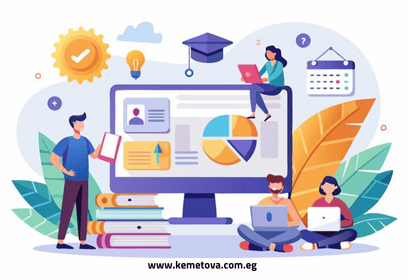
Educational website design isn’t limited to academic institutions anymore; it’s become a practical option for businesses and individuals who want to offer an interactive learning experience that’s easy for their audience to access. As they’ve spread, educational websites have become a core part of modern learning. Digital transformation has changed how people access knowledge and clearly increased learners’ reliance on online platforms.
Studies suggest that most learners feel online learning helps them gain skills traditional education doesn’t offer. This shift has encouraged teachers, trainers and educational institutions to build their own platforms for presenting lessons and training materials and reaching a bigger audience more easily and effectively.
If you’re planning to start a business in this field, you need to understand the basics of educational website design and follow well-planned steps that lead to a complete platform that serves your goals.
In this article, you’ll learn what interactive educational website design means, why it matters, the types of educational sites and the key features they need.
What Does Building an Interactive Educational Website Mean?
In general, designing an educational website means creating a digital space where education providers can present their content online, and learners can access and benefit from it remotely instead of attending in person. This content can take different forms, such as text, audio and video.
An educational website shares some features with other websites, but it differs from them in important ways. That’s why it’s essential to consider the qualities that set educational sites apart, to deliver a clear, effective learning experience.
Educational website design aims to present study or training content online in an organized way that’s easy to learn from and follow. An interactive site gives learners more than reading or watching videos: it lets them participate, give feedback, take tests, interact with teachers and apply what they learn step by step.
When we talk about interactive educational website design, we mean building in digital learning tools that strengthen learning, such as forums, virtual classrooms, question banks, progress tracking and digital certificates. All these tools make learning more effective and encourage learners to keep going.
Why Educational Website Design Matters
Demand for educational website design has grown significantly. A website gives any educational institution, or even a trainer offering courses, a professional presence, especially with today’s technological revolution. Being online has become essential for any educational organization that wants to develop its services to meet what learners expect today. Since 2020, most universities have moved at least part of their teaching online, and the global e-learning market is forecast to keep growing to hundreds of billions of dollars.
Here’s why educational website design matters for individuals and institutions:
A strong, professional impression
A well-built educational website presents a professional image of the institution, which builds trust and credibility with the public, encourages new learners to join and strengthens the loyalty of current learners.
More learners
When content is available online, an institution can go beyond geographic borders and reach new audiences in different countries and regions. This opens the door to bigger growth and gives the business a stronger presence on a wider scale.
Supporting continuous learning
An educational website gives constant access to content, anytime and from anywhere, which makes learning more flexible and easy. That saves time and effort for learners and trainers alike, and lets them put their energy into better learning results.
Introducing your trainers
An educational website also helps you showcase your trainers and present their experience and qualifications clearly, which builds learners’ trust and strengthens the trainers’ professional presence.
Selling courses online
An educational website is a key step for any trainer offering a range of educational services. It lets you present and sell your specialist courses easily, which helps you earn steady income online.
Easy content updates
An educational website lets you edit lessons and add new ones at any time, which keeps improving your content’s quality and helps you promote new courses easily and without complications.
Lower costs
An educational website reduces the costs of traditional education, such as printing books and paper files. Digital content can also be reused many times at no extra cost, which makes growth more sustainable and less expensive.
Read also: why web design matters for businesses today.
The Main Types of Educational Websites
Before you start designing an educational website, decide which type of site fits your educational goals. Here are the main types:
- Course platforms
Websites that offer paid or free courses, which can include videos, PDF files, short quizzes and a certificate system.
- School or academic institution websites
These focus on presenting curricula, timetables and student and teacher files, and often include a dedicated portal for registration and class management.
Language learning websites
Sites dedicated to teaching languages through structured lessons, exercises and interactive activities that help learners progress step by step.
- Digital libraries and databases
Platforms that give direct access to e-books, academic journals, research and a variety of educational materials.
- Educational video websites
Sites whose content is mainly educational videos on different topics, relying on learners to follow the learning process on their own.
- Educational game websites
Sites that combine fun and learning, offering interactive experiences that encourage learners to keep going thanks to their entertaining, engaging style.
- Self-study sites based on articles or text lessons
These offer simplified content through articles and written lessons, with the option to add images, tables and files.
- Interactive learning websites
This type of educational site includes educational games, simulations, virtual labs and interactive learning platforms based on hands-on practice.
- Membership learning platforms
Users subscribe monthly to access premium, exclusive content, such as the online learning platform Coursera .
Choosing the right type helps you decide which tools you need for a professional educational website design and which features to add.
Read also: how a school website affects a school’s performance.
The Features Every Educational Website Design Needs
For your business to succeed and deliver a strong learning experience, you need these core features:
1. Ease of use
The site’s interface should be simple and easy to understand, because learners don’t want to waste time looking for lessons; they want to get to them quickly and without complications.
2. An effective content management system
Use a system that supports multimedia and lets you add courses, lessons, tests and certificates easily, and that also supports multiple languages.
3. Responsive design
Your site needs to work on every kind of device. It isn’t enough for an educational website to look good on a computer; it also needs to work on phones and tablets, especially as more users rely on these devices to access educational content.
4. Interactive tools
When designing an educational website, it’s best to add interactive tools such as forums, discussion rooms, tests and progress tracking to improve the learning experience.
5. Fast loading
Page load speed has a big effect on user experience and on your site’s ranking in search results, so make your site load as fast as possible.
6. Safety and security
It’s essential to provide the highest levels of security to protect user data, use encryption and back up data regularly to avoid losing it and limit any potential breaches.
In conclusion, educational website design isn’t an option anymore; it’s an important need for any business or individual who wants to offer an effective online learning experience. By focusing on good content, an interactive structure and ease of use, you can build a strong educational platform that serves your goals and grows over time.
If you want to launch a professional educational website that meets learners’ expectations and strengthens your online presence, Kemetova offers website design of every kind, including interactive educational websites built to the highest quality standards. We also offer search engine optimization to make sure your business appears at the top of the results, along with reliable web hosting and domain registration to help you launch with confidence.
Start your journey toward a successful learning platform now, and let Kemetova handle the details.