
Most agency case studies are written to flatter. This one is written to be useful. Rivermead Global Egypt is a Hurghada agency that sells, rents and furnishes homes across Hurghada, Sahl Hasheesh, Soma Bay and El Gouna, and Kemetova has worked with it on two separate engagements: the website itself, and a long-running organic search programme. Between them they show what it takes for a property business in a crowded resort market to turn a website into a lead source rather than a brochure.
The numbers below come from Google Search Console and are the ones published on the corresponding Kemetova portfolio entries. Where we describe how we worked, we describe method and reasoning, not secret sauce, because the method is what transfers to your own business.
The business problem: two businesses, one audience
Rivermead Global does two things that most agencies in Hurghada keep apart. It lists new developments, resale apartments and holiday rentals. And it furnishes those homes with ready-made packages such as loft beds and custom kitchens. The commercial logic is sound: a buyer who has just completed on an apartment in Sahl Hasheesh is the best possible prospect for a furniture quote. The website had to make that second sale possible inside the same visit as the first enquiry.
The audience added a second constraint. Rivermead sells to people who are not in Egypt when they begin researching: UK and German buyers comparing resorts on a laptop at night, often months before they book a viewing. Those buyers do not search in Arabic. They search by resort name, by price band, and by questions about moving: what living costs, how residency works, whether ownership is safe. A site that cannot be found for those searches in English and German does not exist for this market.
So the brief had three parts: one site serving sale, resale, rent and furnishing; two languages built properly rather than bolted on; and a search strategy aimed at buyers who are already close to a decision.
Engagement one: the website
Information architecture before design
We started with the structure of the inventory, not the look of the homepage. Property sites fail most often because the listing model is an afterthought. We separated the catalogue into new properties organised by area, resale homes, and rentals in Hurghada, each with its own landing page and its own filter set. A new development in Soma Bay and a one-bedroom resale in Hurghada marina are different purchases with different questions, and forcing them into one undifferentiated grid hides both.
The furniture side was given its own section with its own quote request form, linked from every listing. This is the conversion architecture that matters most in this build: a visitor looking at an apartment sees, on the same page, a path to furnishing it. One site, two revenue lines, a single enquiry flow that feeds both.
Platform and performance choices
The site runs on WordPress with Elementor Pro and JetElements, which gave the Rivermead team flexible listing and service pages they could maintain without calling a developer for every change. Rank Math handles on-page SEO in both languages, and page caching sits behind Cloudflare for fast load times. For a property site with image-heavy listings and an international audience, delivery matters as much as design. A buyer in Manchester loading a gallery over mobile data will leave a slow page without telling anyone why.
We are candid about the trade-off. A page-builder stack is fast to build and easy to edit, and it carries more front-end weight than hand-coded templates. That is the right trade for a business that needs to add listings every week. It is also why the site is being upgraded to custom code: once the content model and conversion paths have been proven, moving the heaviest templates to purpose-built code is a measured performance investment instead of a speculative rewrite. See our guide on WordPress development and the earlier piece on choosing between WordPress and Laravel for the thinking behind that sequence.
English and German as separate markets
The full site exists in English and German, with hreflang tags so Google serves the right version to the right searcher. This is more than translation. German buyers look for different reassurances than British ones, they read longer pages before enquiring, and they search with different vocabulary. Each language version was treated as its own set of landing pages with its own titles, descriptions and internal links. The pitfalls we see most often on multilingual websites are duplicate slugs, hreflang tags that do not point back at each other, and translated pages that quietly canonicalise to the original. The build avoided all three.
Engagement two: the SEO programme

The competitive reality
Rivermead competes with dozens of agencies and developers for the same resort names and the same foreign buyers. A generic strategy of targeting terms like “property in Hurghada” would put a young site against portals with far greater authority and years of backlinks. We did not try to win that fight head on.
Own the shortlist searches
The strategy was to own the searches buyers make once they have a shortlist: the resort and compound names themselves. A buyer who types the name of a specific resort is late in the funnel. They have already chosen a neighbourhood and a price tier, and they want facts: unit types, facilities, distance to the beach, who the developer is, what comparable units cost. Few agencies publish that depth for every compound they sell.
So the work began with keyword research around every resort and compound the agency sells, then a dedicated project page for each one. Each page answers the questions that search implies instead of repeating a brochure paragraph. The result, over time, is a set of pages that Google can match to very specific queries with little competition from the big portals, because the portals rarely write about individual compounds at that level.
Answer the questions buyers ask before they move
The second layer addressed the bigger questions that precede any purchase: the cost of living, residency through property, the practicalities of relocating. These are long-form guides written for relocating buyers. They attract people early in their research, build trust before any sales conversation, and create natural internal links into the relevant resort and listing pages. One cost-of-living guide was seen 62,000 times in search results, an audience Rivermead would never have reached through listing pages alone.
That is the pattern worth copying: the top of the funnel earns attention, the resort pages convert it, and the listings close it. Each layer has a different job and a different success metric.
Technical and on-page work
Underneath the content sat technical SEO and on-page optimisation using Rank Math, with every change tracked in Google Search Console. That tracking matters. Without a baseline and a monthly review, an SEO programme is a faith exercise. With one, you can see which pages are gaining impressions, which queries sit on page two and deserve a content refresh, and which pages Google has not yet indexed.
What the data shows
These figures come from Google Search Console for the Rivermead Global Egypt property, and they are the ones published on the portfolio entry.
- Organic clicks grew from 48 in June 2025 to 1,002 in May 2026. That is roughly a twenty-fold increase in monthly clicks over eleven months.
- Over 16 months the site earned more than 8,200 clicks and 526,000 impressions, with the average position improving from 26 to around 7. An average position of 26 sits on the third page of results, where almost nobody clicks. Around 7 puts a typical query on the first page.
- Top results for resort names such as Marina Palace, Ibiza Bay and Marvento, plus the cost-of-living guide described above.
Read these numbers carefully, because they are easy to misuse. Clicks are the figure that matters, since they are visits from real searchers. Impressions show reach and tell you where the next opportunity is. Average position is a blended number across all queries, so it moves as a site starts ranking for many more long-tail terms; the improvement from 26 to about 7 is a strong signal, but it should be read alongside clicks, not instead of them.
We are also precise about what the data does not show. Search Console measures visits from Google, not enquiries or sales. We are not publishing a lead count or a revenue figure for Rivermead because those belong to the client, and inventing them would defeat the purpose of a case study. The programme is ongoing, which is why the portfolio entry lists its completion date as ongoing rather than closed.
Why it worked: five principles you can reuse
1. Start from the buyer’s shortlist, not the broad keyword
Broad terms are expensive to win and often attract the wrong visitor. Specific names and specific questions attract people who are already deciding. For real estate, hospitality and tourism clients, the most valuable queries usually contain a proper noun.
2. Build the content model before the pages
A page for every compound is only possible if the site is structured to hold one. The decision to separate new, resale and rental inventory, and to give resorts their own pages, was made at the architecture stage of the website engagement. The SEO programme then had a structure to fill. Retrofitting that structure later is slower and riskier.
3. Treat language as a market, not a feature
German-speaking buyers do not want an English page translated word for word. They want the same facts framed for their concerns, with correct hreflang so they land on the right version. This is a fixed cost in a multilingual build and a large advantage over competitors who skip it.
4. Put the second revenue line inside the first conversion path
The furniture quote request sits where the property enquiry happens. That single decision turns a property visitor into a candidate for a second purchase without any extra traffic cost. If your business has an adjacent service, such as interior fit-out, property management or relocation support, put it in the same flow.
5. Measure monthly and refresh what sits on page two
Search Console shows queries where a page ranks between positions 8 and 20. Those are the cheapest wins in any programme: expand the page, tighten the title, add an internal link, and watch it move. A monthly review of those pages is where compounding comes from.
What we would do differently
A case study that lists only wins is marketing. Three things we would plan earlier on a similar project.
First, conversion tracking from day one. The programme is measured in clicks and impressions, which prove visibility but not business impact. On a new build we now connect enquiry form submissions and WhatsApp clicks to Analytics goals before launch, so the report that goes to the client ends with enquiries, not only traffic.
Second, a faster templating layer sooner. The page-builder stack served the first phase well, but listing and resort templates are the pages that earn the most traffic and they are the ones that benefit most from custom code. That is the reason the site is being upgraded to custom code, with the heaviest templates moving first.
Third, a defined content cadence agreed with the client at kickoff. Property inventory changes weekly, and listing freshness is a ranking and trust signal. Agreeing who updates what, and when, avoids the slow decay that follows many launches.
What this means if you run a property or hospitality business
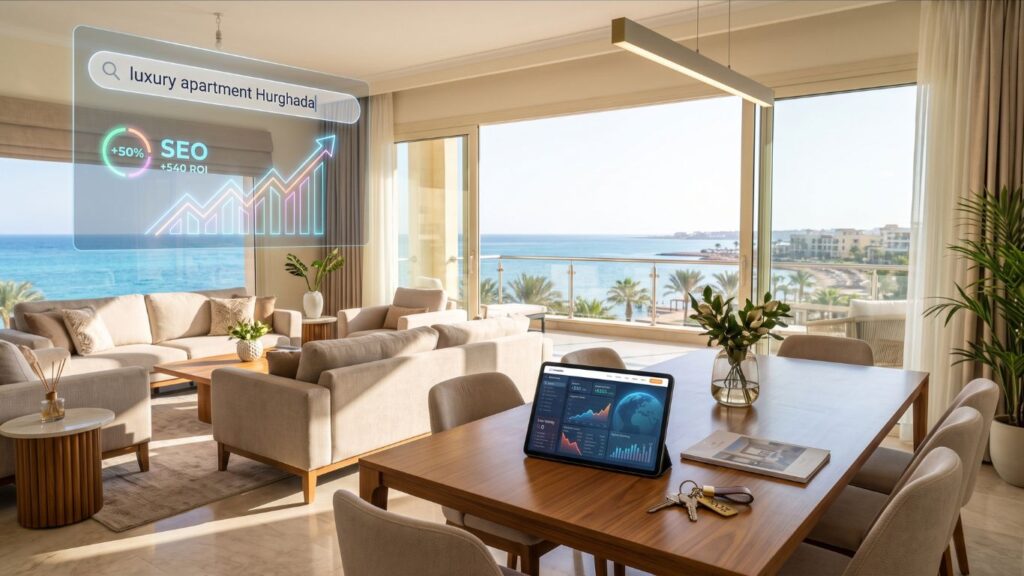
The Rivermead approach is not specific to Hurghada apartments. It applies to any business that sells a high-consideration product to buyers who research for weeks: developers, serviced apartments, hotels with direct booking ambitions, dive centres selling multi-day packages, clinics and corporate services firms. The sequence is the same. Establish a content structure that can hold specific pages. Write for the late-funnel queries first, because they convert. Add the early-funnel guides that build trust and feed the rest. Build every language as its own market. Measure monthly and act on what the data shows.
If you want to see where your own site stands, start with Search Console. Look at the queries where you already appear on page two, the pages with impressions but almost no clicks, and the compound, product or service names you sell that have no dedicated page. That list is your first quarter of work. Our real estate website and SEO service follows this process, and the SEO cost guide explains how programmes like this are scoped and priced in Egypt.
The two portfolio entries behind this article are the Rivermead Global website and the Rivermead Global SEO case study. The shortlist searches that moved a 48-click site past 1,000 clicks a month were available to every competitor in Hurghada; the difference was building the pages that answer them, one resort at a time.