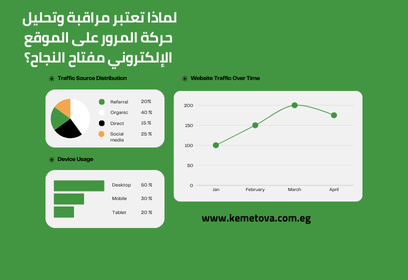
Why is monitoring and analyzing your website traffic the key to success online?
With growing demand for websites in today’s digital marketing world, monitoring and analyzing website traffic and improving performance have become some of the most important factors in any digital strategy’s success.
As online competition grows every day, website owners need a complete understanding of how visitors behave on their sites, so they can improve the experience, increase conversions and reach their business goals.
Monitoring and analyzing website traffic is an essential tool for improving your site. It gives you important insights into where visitors come from, how they engage with your content and whether your site is reaching its goals.
In this article, we’ll look at how to monitor and analyze your website traffic and improve your site’s performance with reliable tools and techniques.
What Is Website Traffic?
Website traffic is the number of users or visitors who browse your website over a given period. Monitoring and analyzing it is an important measure of your site’s success, because it shows how well your site attracts visitors and how they engage with it.
The main types of website traffic are:
- Organic traffic comes from search engines such as Google. These are visitors who reach your site after searching for specific keywords, without paid ads.
- Direct traffic happens when visitors type your site’s address straight into their browser or reach it through a saved bookmark.
- Paid traffic comes from paid online ads, such as Google Ads or social media ads.
- Social traffic comes from social media platforms such as Facebook, X (formerly Twitter) and others.
- Referral traffic happens when visitors click a link to your site from another website.
Why Monitoring Website Traffic and Performance Matters
Monitoring and analyzing website traffic and performance are essential to any website’s success online. They let you analyze all the data about your visitors and understand how they engage with your content, which helps you improve the user experience and increase engagement.
Traffic analysis also lets you measure your site’s overall success and find hidden opportunities to improve performance, whether by improving your content or speeding up your pages. That helps you reach your site’s main goals, whether that’s increasing sales or engagement with your content.
In short, monitoring and analyzing website traffic helps website owners understand where visitors come from, improve their content and user experience (UX), and make the right decisions to improve performance.
The Best Tools for Monitoring Website Traffic and Performance
The first step in monitoring and analyzing website traffic is using the right tools. There are many tools that give you deep insights into how visitors and users behave, and how to greatly improve your site’s performance. Here are some of the most widely used:
- Google Analytics: one of the best tools, giving you accurate data on traffic sources, how users behave on your site and your most-visited pages, as well as conversion rates and the goals you’ve set.
- Google Search Console: monitors your site’s performance in Google search. It gives you reports on the keywords your site appears for, impressions and clicks, indexing errors and SEO issues.
- Ahrefs and Semrush: ideal for analyzing backlinks and keywords and improving SEO. They help you see how your site performs compared with competitors, and give you ideas for keywords that bring traffic to your site.
- Hotjar: an advanced user behavior tool that uses heatmaps to show you where visitors click and how they browse your site.
Key Metrics for Monitoring Website Traffic and Performance
Once your tools are set up, focus on your site’s key performance indicators (KPIs). These metrics help you assess the quality of your traffic and how well your site is reaching its main goals:
- Traffic volume
The number of visitors shows how well your site attracts people. Analyze where your traffic comes from, whether organic search, paid ads or direct visits.
- Session duration
This metric shows how long visitors spend on your website. A longer duration means visitors find your content interesting.
- Bounce rate
Your bounce rate shows the percentage of visitors who leave your site after viewing only one page. A high bounce rate suggests visitors didn’t find the content relevant, or had a poor experience browsing your site.
- Conversion rate
Your conversion rate measures how well your site reaches its main goals, such as completing a purchase or signing up for a service. It’s one of the most important metrics for website owners.
- Pages per session
This metric shows how many pages visitors view in one session. A higher number generally means users find complete, useful content on your site.
Analyzing User Behavior
Understanding user behavior clearly and accurately is a core part of website traffic analysis. Knowing how visitors interact with your content does a lot to improve the user experience and increase conversions. Here are some important ways to analyze user behavior:
- Heatmaps: visual reports on the most active parts of your site, showing where users click most, which helps you place important elements such as call-to-action (CTA) buttons better.
- Click and movement tracking: with tools such as Hotjar, you can track clicks and browsing paths to see how users move between your pages, so you can improve your site structure and guide visitors toward your goals.
- User journeys: analyze the steps visitors take to reach specific goals on your site, such as completing a purchase or signing up for a service. This helps you find every point that needs improving to increase conversions.
Analyzing Content Performance
After monitoring user behavior, analyze how the content on your site is performing. Content is the foundation of any website, so make sure it attracts visitors and encourages them to engage. There are several ways to analyze content performance:
- Engagement rates: the number of comments, shares and likes your content gets. The more engagement, the better the content quality and the better it fits your audience’s interests.
- Keyword analysis: use SEO tools to analyze the keywords that bring visitors to your site. If your site attracts visitors through irrelevant keywords, you may need to improve your SEO strategy. See this guide to the best SEO strategies for improving your rankings.
- Page titles and descriptions: these are among the most important factors in attracting search traffic to your site. Make sure your titles are attractive and spark curiosity, and that your descriptions contain the right keywords.
Analyzing Site Speed and User Experience (UX)
Your website’s performance doesn’t just depend on content and visitor behavior; it’s also affected by technical factors such as page load speed and user experience. Learn why improving the user experience matters for your site’s success. If your site is slow or doesn’t work well on smartphones, you could lose a lot of visitors.
You can measure your page load speed with a tool such as PageSpeed Insights, which analyzes how fast your pages load and suggests improvements. Site speed is a key factor in search rankings and user experience.
Also make sure your site is mobile-friendly and gives users a smooth, simple experience on every type of device.
Creating Performance Reports
Once you’ve collected and analyzed all your traffic data, it’s time to create reports. They should be complete, easy to understand and help you make the right decisions based on data. Good reports include:
- Monthly performance reports that compare your site’s performance over different periods.
- Reports comparing your site’s performance with your competitors’.
- Recommendations for improving performance, based on the data you’ve collected, such as improving content or the user experience.
Monitoring and analyzing your website traffic and performance is a key part of any website’s success. By using the right tools and focusing on the key metrics above, website owners can find their strengths and weaknesses and take action to improve performance and increase conversions. Most importantly, monitoring traffic and improving performance is an ongoing process that keeps you successful over the long term.
If you have any questions about monitoring and analyzing your website traffic, get in touch, and a member of the Kemetova team will get back to you. At Kemetova, we offer every website service you need, from design and development to maintenance and fixing errors, as well as web hosting and domain registration.