
A hotel website has one commercial job: to turn a visitor who is already interested in your property into a confirmed booking that does not pass through an intermediary. Everything else, from the photography to the typography, is in service of that job. When we look at hotel sites across the Red Sea, the pattern is consistent. The design is often attractive, but the booking path is slow, the rates are hard to trust, the languages stop at the home page, and nobody can say how many reservations the site really produced last month.
This guide lists twelve features that separate a brochure from a booking engine. They are ordered roughly by commercial impact, and each one is described the way an engineer would specify it: what it does, how it should behave, and what usually goes wrong. It is written for owners and general managers who sign off the budget, and for the people who have to build and operate the result. If you want the commission arithmetic that justifies the investment, read our comparison of direct booking and Booking.com for a Hurghada hotel first. If you want the cost side, see how much a booking system costs in Egypt. This article covers what the site itself must do.
Why Features, Not Templates, Decide Direct Bookings
A guest who lands on your site has usually already seen your property on an online travel agency. They arrive with a specific question: is it cheaper or better to book here, and can I trust this site with my card? Every feature below answers some part of that question. A site that answers it quickly converts. A site that makes the guest hunt, wait, or doubt sends them back to the marketplace, where the commission is paid on a booking you had already earned.
That is why a general-purpose template rarely performs. Templates optimise for looking finished. Booking performance comes from behaviour: how fast the availability check returns, whether the final price matches the first price, whether the confirmation email arrives. Those are engineering properties, and they need to be specified before the design is approved.
1. A Booking Engine on Your Own Domain
The first feature is the one most often compromised. The guest should be able to search dates and see real prices without leaving your domain, or at minimum without a jarring change of look and address. When a hotel hands guests off to a third-party engine on an unrelated URL with a different design and no language selector, guests tend to hesitate at the handoff, because an unfamiliar address reads as a risk signal.
Specify it this way. The search form sits in the first screen on every page that sells rooms, on mobile as well as desktop. It asks for the minimum: check-in, check-out, guests, and children’s ages only when children are added. The results page lists room types with the total price for the stay, not only a per-night figure. The whole flow runs on a hosted subdomain or inside your own application, with your branding, your language, and your analytics. If you use a vendor engine, ask whether it supports a custom domain, a consistent header, and event hooks for tracking. If you build one, treat it as a product with its own tests, not as a plugin dropped into a page.
2. Live Availability and Rate Integrity
A direct channel that shows stale availability destroys trust faster than any design flaw. If a guest chooses a room and the system later says it is gone, they will not try again. The site must read inventory from the same source of truth that feeds your channel manager and property management system, and it must reflect changes within a short, known interval.
The engineering questions are concrete. Is availability read live from the property management system on each search, or from a cache refreshed every few minutes? If cached, what is the maximum staleness, and what happens at the last room? Is there a hold on the room while the guest enters card details, and does the hold expire? Two guests will reach the final step for the same last room at some point; the system must resolve that with an atomic reservation, not with an apology email. Rates need the same discipline. If your published rate on the website is higher than the rate an online travel agency shows for the same room and dates, the agency’s rate parity clause may be the reason, but the guest only sees that you are more expensive. Agree internally, and with your channel manager, how rate parity and direct-only offers will be handled before the site goes live.
3. A Visible Reason to Book Direct
Guests will not guess why booking direct is better. You have to state it, near the search form and again in the results. A good direct-booking proposition is specific and honest: a best-rate guarantee that you can actually honour, a benefit that marketplaces do not offer, such as flexible check-in, a room upgrade subject to availability, a complimentary late checkout, or a package that includes transfers or a dinner. The proposition should be written for the guest’s benefit, not as a complaint about commissions.
Operationally this means the booking engine must support rate plans that are visible only on your site, or benefits attached to a plan, and your front desk must be briefed to honour them. A promise on the website that the reception team does not know about turns a conversion feature into a complaint. Review the wording with the people who will answer the phone on arrival day.
4. Mobile Speed That Survives a Hotel Wi-Fi Reality
Speed also affects discovery. According to Google’s official Core Web Vitals guidance, a good user experience targets Largest Contentful Paint within 2.5 seconds, Interaction to Next Paint below 200 milliseconds, and Cumulative Layout Shift below 0.1.
For a hotel site the usual causes of slowness are predictable. The hero image or video is the largest element and is loaded without priority hints or correct sizing. Image galleries load every photograph at full resolution. Fonts for several languages are loaded in full. Chat widgets, review widgets, map embeds and tracking tags compete for the main thread. Fixing these is routine work, and it is covered in our guide to page speed optimisation. The point for this checklist is that speed must be a requirement with a number attached, tested on a mid-range phone, before the design is signed off. Hosting location and caching strategy also matter, which we examined in hosting in Egypt or abroad.
5. The Whole Journey in the Guest’s Language
Red Sea hotels sell to guests from several markets at once. English, German, Russian and Arabic are the obvious ones, and some properties add Polish or Czech. A language switcher that translates the home page and then drops the guest into an English-only booking form loses exactly the guests who needed the translation most. The booking engine, the policy text, the validation messages, the confirmation email and the payment page all need to be in the selected language.
Specify language as a property of the guest session, not of a page. The language chosen on the first page carries through search, room selection, extras, payment and the emails that follow. Right-to-left layout must be tested for Arabic, including date pickers, phone number fields, and the order of price and currency symbols. Currency display should be explicit: show the currency the guest will actually be charged in, and make clear whether a converted figure is an estimate. Each language also needs its own search presence, with correct hreflang annotations and local-language titles, which we describe in detail in our guide to multilingual SEO for Red Sea tourism sites.
6. Room Pages That Sell the Specific Room
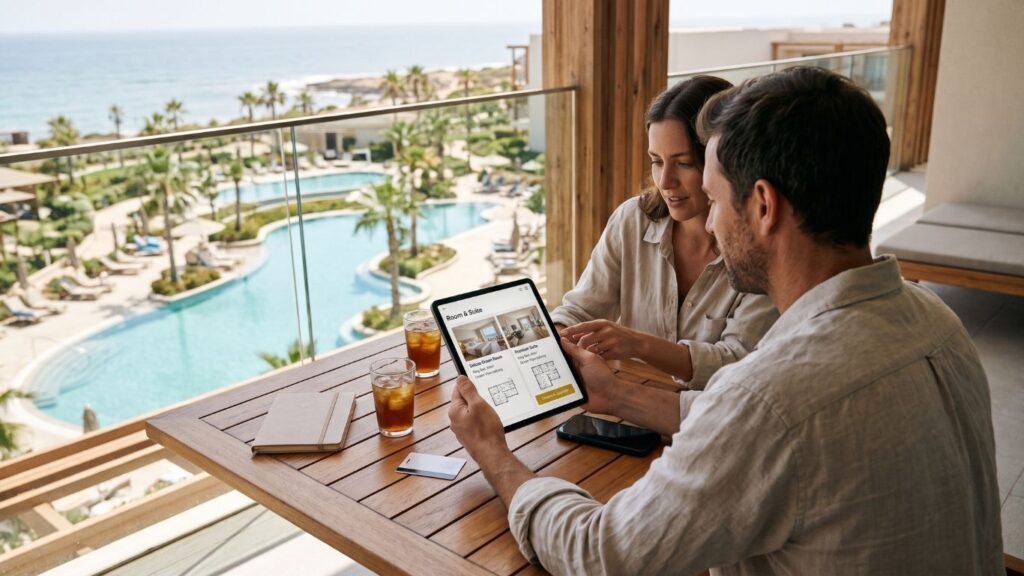
Many hotel sites describe rooms in a single paragraph and a gallery. Guests compare rooms, and they search for specifics: sea view, family room, connecting rooms, accessible bathroom, balcony, bed configuration, size. Each room type deserves its own page with a clear, structured specification, because that page also becomes a search landing page for long-tail queries and because it is the page a guest will share with their travelling companions.
A strong room page has a short factual summary at the top, a table of fixed attributes such as size, maximum occupancy, bed types and view, a list of inclusions, honest notes about what is not included, the cancellation terms that apply, and a direct link into the booking engine with the room preselected. The wording should be unambiguous. If a room has a garden view and not a sea view, say so; a guest who feels misled at check-in writes the review that costs you the next ten bookings. Add structured data to describe the property and rooms in a machine-readable way, following Google’s documentation, and keep it consistent with the visible text.
7. Total Price Honesty
The fastest way to lose a direct booking is to show one price on the room page and a higher one at payment. Guests treat late additions as a trick. Taxes, service charges and mandatory fees must be shown, or clearly stated as included or excluded, before the guest invests effort in the form. If a city or resort fee is payable at the hotel, say so in the results, not in the terms at the bottom of the last step.
Build this into the price model rather than the copy. The engine should calculate a total for the stay from the same components in every screen: room rate, extras, tax and service lines, and any discount. The same function should produce the figure on the results page, the summary, the payment page, the confirmation email and the invoice. Divergent calculations in different templates are the usual source of mismatches, and they are expensive to find after launch. Test with edge cases: children with different pricing, extra beds, long stays crossing rate periods, and promotional codes combined with packages.
8. Payment That Guests Trust and Finance Can Reconcile
Payment is where a booking either completes or disappears. The checkout should use a hosted or tokenised card form from a reputable payment provider, so that card data never touches your server. It should show the accepted card brands, support 3-D Secure authentication where the issuer requires it, and clearly state when the card will be charged: at booking, as a deposit, or at the hotel. Offering a pay-at-hotel option or a deposit-only plan helps guests who are uneasy about prepaying to an unfamiliar site, provided your cancellation and no-show terms protect you.
Behind the form, the engineering matters as much as the interface. Payment notifications arrive asynchronously, so the booking status must be driven by a verified webhook from the provider, not only by the browser returning to a success page. Each payment attempt needs an idempotency key, so a double click or a timeout does not charge the guest twice or create two reservations. Refunds and partial refunds should be recorded against the original transaction. Finance should be able to export a daily reconciliation that matches payments to reservations without manual searching. If you accept foreign cards, confirm with your provider which currencies you can settle in and what the guest sees on the statement.
9. Trust Signals That Are Real
A guest deciding whether to give a card number to a hotel site looks for evidence that the business is real and reachable. Useful signals include a physical address with a map, working phone and email, a named general contact, a link to your Google Business Profile, visible policies for cancellation, privacy and payment, and a selection of genuine guest reviews with their sources and dates. Badges that look official but mean nothing are worse than none.
If you display reviews, display real ones and keep them current. A live feed from a review source is better than a hand-picked set of five-star quotes pasted a year ago, and a mix of ratings reads as more believable than uniform praise. Do not hide negative reviews, and answer them in public in the same language they were written. Guests read the replies as much as the reviews. Keep your Google Business Profile verified, with details identical to the website.
10. A Human Fallback for Groups, Special Requests and Doubts
Not every booking fits a form. Groups, long stays, weddings, corporate blocks, accessibility needs and guests who want to ask a question first will not complete a standard engine. If the site gives them no easy alternative, they leave or they go to an agent. Provide an enquiry route that is as visible as the booking button: a short form with dates and party size, a click-to-chat link for the messaging app your guests actually use, and a phone number written in international format.
Treat enquiries as leads with a response standard. Route them to a named person, show an expected response time, and log every message in a shared inbox or CRM so that nothing depends on one phone. Pre-fill the context of the page the guest came from, for example the room type or dates they were viewing, in the message template. Track enquiries separately from bookings so you can see how many arrived and how many converted. A site that converts on forms but ignores enquiries for a day teaches guests that the human side is unreliable.
11. Confirmation and Pre-Arrival Emails That Arrive and Work
The booking is not finished when the guest pays. The confirmation email is the document they will show at the door, forward to a travelling partner, and open in a panic when the transfer does not appear. It must be sent immediately, contain every operational detail, and land in the inbox rather than the spam folder.
Contents should include the guest name as booked, dates, room type, occupancy, total paid and balance due, the cancellation terms that applied at the time of booking, check-in and check-out times, the address with a map link, and a contact route that works outside office hours. Add a pre-arrival message a few days before the stay with arrival instructions, optional extras such as transfers, dining, spa and excursions, and a clear link to manage or amend the booking. These upsell moments are where a direct channel earns more than the room rate, because the guest is already committed and the relationship belongs to you.
Technically, email from your domain must be authenticated with SPF, DKIM and DMARC, sent through a transactional email service rather than the web server’s default mail function, and monitored for bounces. Send templates in the guest’s language and keep plain-text versions. Test every email on the major mailbox providers, and keep a log of each message sent for each booking so support can answer the question of whether it was delivered.
12. Measurement You Can Defend in a Management Meeting
The last feature is the one that decides whether the other eleven keep their budget. If you cannot say how many bookings the site produced, from which markets and channels, and at what conversion rate through each step, then every decision about the site is an opinion. Set up measurement before launch and treat it as part of the build.
A workable event plan tracks the search, the room view, the room selection, the start of checkout, the payment attempt, the confirmed booking with its value, the enquiry submission and the click-to-chat or phone tap. Name events consistently, pass the booking value and currency with the confirmed booking, and make sure that the confirmation event fires once, even if the guest reloads the page. Do not send personal data such as names or emails to analytics. Connect Google Search Console to see which queries bring guests, using the routine in our guide to the five Search Console reports that matter, and reconcile the booking events against the reservations recorded in your property management system each month. The two should match within a small, explained margin. When they do not, the difference is a bug or a tracking gap, and either one is worth finding.
Report the numbers that management can act on: the share of bookings that come direct, the conversion rate from search to confirmed booking, the abandonment rate at each checkout step, the split by language and device, the average booking value, and the number of enquiries answered within the target time. Put them next to the commission paid to intermediaries for the same period, and the value of the website becomes a figure rather than an argument.
How to Prioritise the Twelve
Not every property needs to build all twelve at once, and the order matters. A practical sequence for a hotel with an existing site is as follows. First, fix the foundations that cost bookings every day: the booking engine handoff, price honesty, mobile speed and payment reliability. Second, add the features that increase trust and reach: full-journey languages, honest room pages, real trust signals and a human fallback. Third, build the compounding features: confirmation and pre-arrival emails with extras, and the measurement layer that tells you what to improve next. If your platform cannot support the first group, no amount of work on the third group will rescue the result, and that is the moment to discuss a rebuild rather than another redesign.
A simple scoring method helps. For each feature, rate your current site from zero to three: zero means missing, one means present but weak, two means good, three means measured and improving. Multiply the gap by an estimate of how many of your monthly visitors reach that step. The largest products are where the next engineering effort belongs. This is more reliable than choosing features by taste, and it gives the general manager a defensible reason for the order of work.
Questions to Put to Any Supplier
When you brief a web team or a booking engine vendor, ask for answers in writing. How is availability synchronised, and what is the maximum delay? Can the engine run on our domain with our branding and every language we sell in? How is the total price calculated, and is it the same function on every screen? Which payment providers are supported, and are webhooks verified? How are confirmation emails authenticated and monitored? What events does the engine emit for analytics, and who owns the data? What is the plan for the first month after launch, when the real problems appear? The answers to these questions tell you more about the quality of a proposal than its mockups do. For a wider view of how to evaluate a local partner, see our list of ten questions to ask before you sign with a web designer in Hurghada. For the overall approach to hospitality projects, our hotels and hospitality page and booking systems page describe the scope we build.
A hotel that can see, every month, how many guests searched, how many reached payment and how many completed, is a hotel that can fund its next improvement from the commission it no longer pays. That is the real test of a hotel website: not whether it looks good in the launch meeting, but whether its booking numbers are higher, and more certain, a year later.